Bpc-157 Reconstitution Calculator Peptide Reconstitution Calculator
Peptide Reconstitution Calculator: a practical way to get BPC-157 right
If you’ve ever opened a vial, tried to “eyeball” the amount of diluent, and then wondered whether your dose is actually correct, you’re not alone. In my hands-on peptide work, the biggest causes of dosing inconsistency weren’t the peptide itself—they were reconstitution math errors, unit confusion, and assuming every vial is the same size.
That’s why I keep a reliable bpc 157 reconstitution calculator workflow. In this guide, I’ll show how to compute the right concentration, how to plan your syringe withdrawals, and how to sanity-check your results so you can reconstitute with confidence.
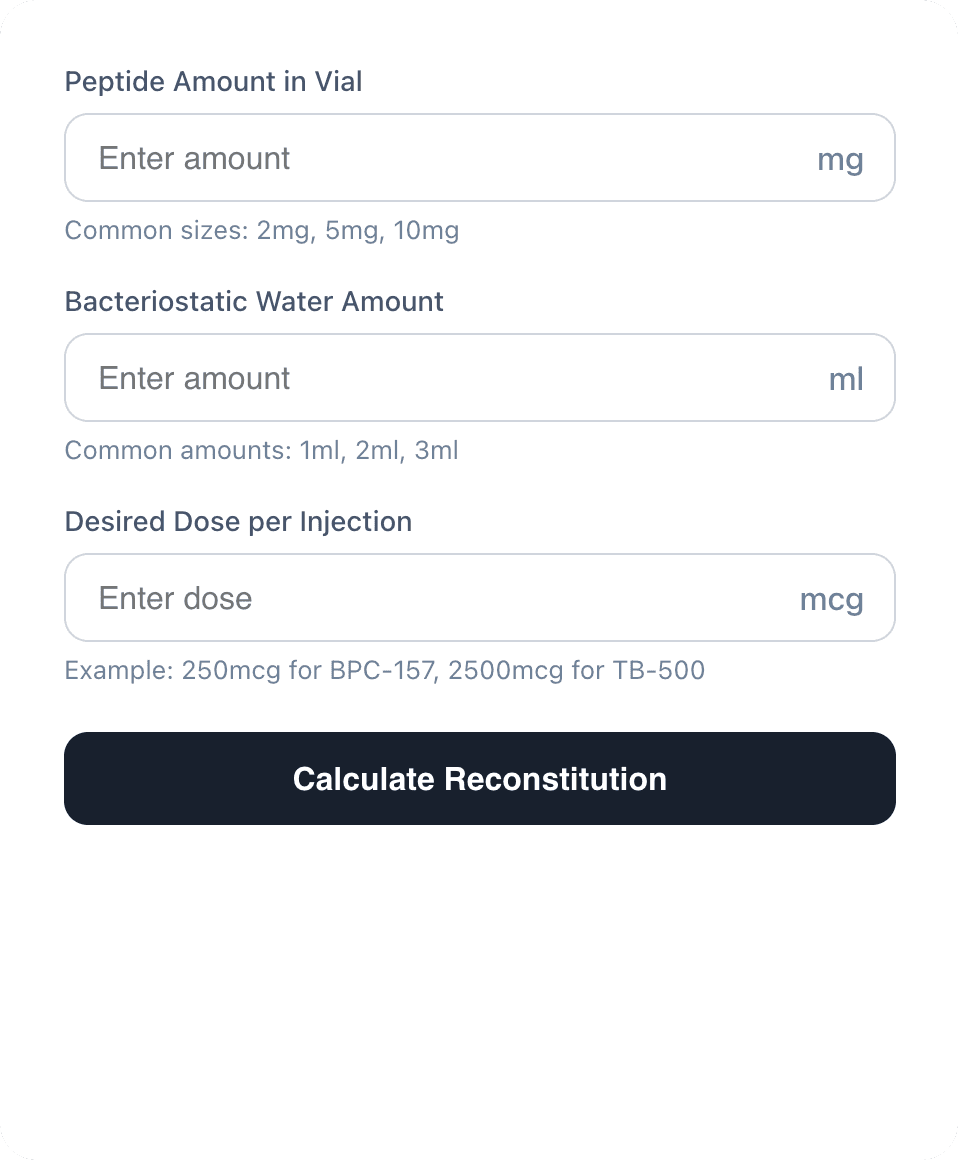
What a “BPC-157 reconstitution calculator” actually does
A bpc 157 reconstitution calculator converts three pieces of information into actionable numbers:
- Vial strength (amount of peptide) — usually listed in mg (or sometimes IU, but most research peptides list mass in mg).
- Diluent volume — how many mL (or sometimes “drops” or “tubes,” which is where mistakes happen).
- Target concentration / dose per withdrawal — so you can draw consistent volumes each time.
Under the hood, the math is straightforward: you’re distributing a known mass into a known final liquid volume. Where people get tripped up is unit conversion (mg vs mcg), and mixing up the difference between total volume added and what you’ll measure into syringes later.
Key units (and the common mistake)
Most dosing plans think in micrograms (mcg) or milligrams (mg), while syringes measure in milliliters (mL) and volume markings are often calibrated in increments like 0.1 mL or 0.01 mL.
In my experience, the most frequent error is treating 1 mg as if it were 1 mL. They’re not related. mg measures mass; mL measures volume. A calculator keeps those concepts separate so you don’t accidentally underdose or overdose.
Core calculations you should understand (even if you use a calculator)
Even when you rely on a calculator, you should know how to verify it. Here are the calculations I use to cross-check results.
Step 1: Convert peptide mass into mcg
Because dose plans often talk in mcg, convert mg to mcg:
mcg = mg × 1000
Step 2: Compute concentration (mcg per mL)
If the total peptide is spread across a known total diluent volume:
Concentration (mcg/mL) = (total mcg) ÷ (mL added)
Step 3: Compute the volume to withdraw for a target dose
If you want a specific amount in mcg (say, a scheduled dose), then:
mL to withdraw = (target dose in mcg) ÷ (concentration in mcg/mL)
Hands-on sanity check: dose should scale linearly
After reconstitution, dose volume should scale linearly. For example, if you double the target dose, the required draw volume should double as well (assuming the solution is uniform). When I see non-linear behavior, it usually means a unit error or an incorrect input volume.
How to use a bpc 157 reconstitution calculator (workflow I recommend)
When I’m building a repeatable workflow, I treat calculator use like a quality-control step, not a one-off convenience.
1) Record vial mass exactly as labeled
Use the label value (e.g., “5 mg” or “10 mg”). If the label uses a different convention, resolve it before you calculate anything. Don’t assume.
2) Choose your diluent volume based on your dosing plan
Your diluent volume affects:
- Concentration (more diluent = lower concentration)
- How precise your syringe draws need to be
If your target dosing requires very small syringe volumes, a lower concentration may lead to “accuracy strain” on the markings. For example, trying to measure extremely tiny fractions on a syringe can increase variability.
3) Enter values carefully (watch decimals)
Most calculator mistakes I’ve corrected for others were simple: entering 0.5 mL as 5 mL, or entering 2.0 as 2.00 with a different unit context.
4) Verify the output with a manual check
Use the three steps above (mcg conversion, concentration, withdraw volume). If the manual math and the calculator output disagree, don’t guess—find the input mismatch.
5) Plan your labeling before you reconstitute
Once reconstituted, the most helpful label info on the vial is:
- Reconstitution date
- Diluent type (as applicable to your protocol)
- Final concentration (e.g., mcg/mL)
- How much volume corresponds to your scheduled dose
This reduces “calculator dependency” during later draws, which is when mistakes happen most often.
Dosing clarity: concentration vs. dose per mL
People sometimes confuse concentration (mcg per mL) with the dose amount. Here’s the distinction I use:
- Concentration tells you how much peptide is in each mL.
- Dose tells you how many mcg you want each time.
- Withdraw volume is the mL you measure from the vial to deliver that dose.
When you set up your bpc 157 reconstitution calculator, make sure it outputs the withdraw volume you plan to measure, not just concentration.
Practical example (to validate your calculator)
Let’s walk through an example so you can confirm your calculator’s logic. (Use your own vial mass and diluent volume.)
- Vial peptide mass: 5 mg
- Total diluent volume added: 1 mL
- Target dose: 500 mcg
Math check
Total mcg = 5 mg × 1000 = 5000 mcg.
Concentration = 5000 mcg ÷ 1 mL = 5000 mcg/mL.
Withdraw volume = 500 mcg ÷ 5000 mcg/mL = 0.1 mL.
If your calculator doesn’t produce 0.1 mL for this scenario, re-check the unit inputs and whether it assumes mL or units like “drops.”
Limitations and where calculators still won’t save you
Even a perfect bpc 157 reconstitution calculator can’t fix process errors. The main limitations I watch for:
- Incorrect input values (wrong vial mass, wrong diluent volume, unit mismatch).
- Measuring/drawing inaccuracies (syringe markings, parallax error, inconsistent technique).
- Assuming uniform mixing (you still need proper reconstitution handling so the solution is consistent).
In short: the calculator ensures the math is right; your technique ensures the solution behaves consistently.
FAQ
How do I choose the diluent volume for BPC-157?
Pick a diluent volume that gives you a concentration where your scheduled dose corresponds to syringe volumes you can measure reliably. If the required draws are too small to read accurately from your syringe, adjust the diluent volume and recalculate.
Why does my calculator show a different draw volume than my previous vial?
It usually comes down to one of these: different vial mass, different diluent volume, or unit conversion differences (mg vs mcg, mL vs “drops”). If you keep the same vial mass and diluent volume, the withdraw volume for a given dose should match.
What should I label after reconstitution?
Label the vial with the reconstitution date, diluent used, final concentration (mcg/mL), and the exact volume that corresponds to your scheduled dose. That lets you draw without repeatedly re-running calculations.
Conclusion: get consistent draws with one repeatable calculator workflow
A bpc 157 reconstitution calculator is most valuable when you use it as part of a repeatable process: enter the labeled vial mass correctly, add your chosen diluent volume, compute concentration, and translate your planned mcg dose into a measurable mL withdrawal. Then validate the result with quick manual math so unit errors don’t slip through.
Next step: Take your current vial label (mg) and your intended diluent volume (mL), run the calculator once, and write the resulting concentration plus “mL per dose” on the vial label before your first draw.
Discussion